


The Most Successful Cities May Feel Like Communities
🌅 A Strange Prediction
For decades, cities competed to become bigger:
- skylines
- economies
- populations
- infrastructure
Bigger was assumed to mean better.
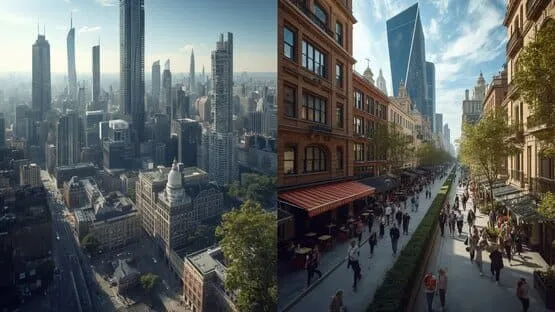
But future cities may not feel bigger.
They may feel smaller, more personal, and more human.
That could become a key competitive advantage.
🧭 The Urban Paradox
Cities offer more opportunity than ever, yet many people feel:
- disconnected
- anonymous
- overwhelmed
- isolated
Surrounded by millions, but still alone. Future success may depend less on size and more on experience.
🏘️ The Community Premium
City comparison:
City A
- strong infrastructure
- global connectivity
- economic growth
City B
- everything above plus:
- walkable districts
- strong local identity
- social spaces
- active communities
- real interaction
Increasingly, City B becomes more attractive. Because people move for belonging, not just opportunity.
📡 Signals of Change
Walkable neighborhoods → consistently outperform expectations
Mixed-use districts → growing demand for integrated living
Community-driven developments → higher pricing power
Lifestyle over size → smaller homes in better communities win
🎭 New Definition of Luxury
Old luxury:
- size
- exclusivity
- prestige
New luxury:
- knowing your neighbors
- walkable daily life
- less commuting
- social connection
- community trust
It is not less value.
It is different value.
🔍 Community as a Metric
Beyond GDP and infrastructure, a key question emerges:
Does this city create social gravity?
Cities with strong social gravity tend to have:
- higher retention
- stronger demand
- better long-term stability
📖 Two Streets
Street One
- perfect infrastructure
- quiet environment
- low interaction
Street Two
- cafés
- people outside
- community activity
- visible belonging
Which feels more alive?
Which would people stay in longer?
🧪 The Neighborhood Test
If prices stopped rising for 10 years: Would people choose:
- appreciation potential
or - better daily life
This reveals what truly drives value.
🌍 Future City Types
- Connected City → built on relationships
- Walkable City → built on convenience
- Flexible City → built on adaptability
- Human-Centered City → built on wellbeing
- Adaptive City → built on resilience
📊 Community Strength Framework
Key drivers of future cities:
- walkability (very high)
- community engagement (very high)
- public spaces (very high)
- social connectivity (very high)
- lifestyle flexibility (high)
- economic opportunity (high)
- housing access (high)
- identity (high)
📰 Future Snapshot (2038)
Cities increasingly measured by:
- wellbeing
- community engagement
- daily life quality
Not just economic output.
💡 What Investors Often Miss
Cities are ecosystems, not assets.
Ecosystems perform best when people want to stay.
Future value may come less from towers
and more from connection.
❓ Key Questions
- Does this city create community?
- Do people build long-term roots?
- Is daily life improving?
- Are neighborhoods connected?
- Does interaction happen naturally?
- Would people stay if prices stopped rising?
🧭 The Shift
Cities may not win by being:
- biggest
- richest
- most famous
They may win by being most human.
Because cities are not just buildings.
They are relationships.
And in a digital world, connection becomes one of the most valuable assets.