


How Your Apartment Will Look in 20 Years — The Scenarios Nobody Talks About
When people buy a property, they think about today.
Maybe the next few years.
Rarely 20.
But here’s the thing:
Real estate doesn’t stay still — even if your walls do.
Everything around your apartment will change.
And slowly… your apartment changes with it.
Not physically at first.
But economically, functionally, and psychologically.
🕰️ Let’s Fast Forward 20 Years
Imagine walking into your current apartment two decades from now.
At first, it feels familiar.
Then something feels… off.
Not broken.
Not bad.
Just not aligned with reality anymore.
🏚️ Scenario 1 — The “Perfect Back Then” Apartment
This is the most common story.
Nothing dramatic happened.
You didn’t make a mistake.
But over time:
- layouts evolved
- standards improved
- expectations shifted
And your apartment?
Stayed the same.
What once felt modern now feels:
- slightly inconvenient
- slightly outdated
- slightly harder to justify the price
Not a disaster.
But no longer competitive.
⚙️ Scenario 2 — The Upgrade You Didn’t Plan For
At some point, the building starts needing things:
- insulation upgrades
- energy systems replacement
- compliance with new regulations
And suddenly:
Owning becomes an ongoing project.
Not optional.
Mandatory.
And expensive.
📡 Scenario 3 — The “Not Smart Enough” Home
Technology doesn’t ask for permission.
It just becomes standard.
In 20 years, basic expectations might include:
- fully integrated smart systems
- energy optimization
- automated environments
And if your apartment doesn’t have them?
It won’t feel charming.
It will feel… behind.
🌍 Scenario 4 — The Location That Quietly Changed
The city didn’t collapse.
But it shifted.
- new districts became attractive
- infrastructure moved
- work patterns changed
Your “great location” is just… okay.
Still fine.
But no longer special.
🧑🤝🧑 Scenario 5 — The Wrong Fit for Future Buyers
The market doesn’t just change.
People change.
- smaller households
- different lifestyles
- new priorities
What used to be ideal:
- large layouts
- rigid spaces
May become:
- inefficient
- hard to adapt
Demand doesn’t disappear.
It just moves elsewhere.
💸 Scenario 6 — The Property You Can’t Easily Sell
This is the one nobody plans for.
Your apartment still exists.
It still has value.
But:
- fewer buyers are interested
- it stays longer on the market
- negotiations get harder
Not because it’s bad.
But because:
It no longer matches what the market wants.
🧩 Scenario 7 — The Apartment That Still Works
This is the quiet winner.
Not the flashiest property.
Not the trendiest.
But the one that:
- adapts
- stays relevant
- fits different types of buyers
- survives changes
It doesn’t fight the future.
It moves with it.
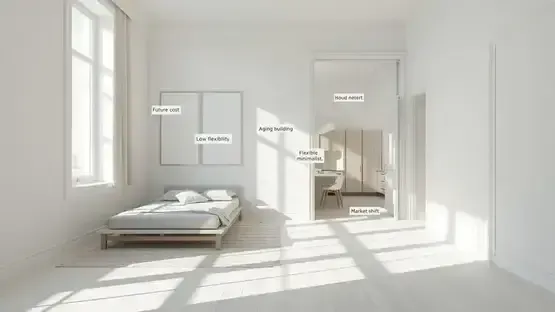
📊 A Simple Way to See It
| Type of Property | What Happens Over Time | Long-Term Outcome |
|---|---|---|
| Trend-driven | Looks outdated | Loses appeal |
| Under-invested | Requires upgrades | Costs increase |
| Tech-resistant | Feels obsolete | Demand drops |
| Rigid layout | Hard to adapt | Limited buyers |
| Flexible & balanced | Stays relevant | Stable value |
🧠 Where Most People Go Wrong
People buy based on:
- how it feels today
- how it looks today
- how it fits their life today
But real estate is not about today.
It’s about how long “today” will last.
📊 Propertiso Insight (CIS Perspective)
When the market is hot, people stop thinking long-term.
High emotional markets (high CIS) push buyers toward:
- aesthetics
- urgency
- short-term thinking
And that increases the chance of choosing:
A property that ages poorly.
Lower, more rational markets do the opposite.
They reward:
- flexibility
- fundamentals
- long-term thinking
🧭 The Question Nobody Asks
Before buying, most people ask:
- “Do I like this place?”
Almost nobody asks:
- “Will this still make sense in 20 years?”
And that one question changes everything.
🚀
Your apartment is not just a place.
It’s a long-term decision that will slowly interact with a changing world.
And the biggest risk?
Is not that something goes wrong.
It’s that everything changes…
And your property doesn’t keep up.