


Why Climate Is Quietly Reshaping Global Property Values
For decades, real estate investors focused on familiar variables. Location. Infrastructure. Employment. Population growth. Interest rates. But a new force is slowly entering the equation. Not as a headline. Not as a political debate. As capital.
Because whether people agree on climate issues or not, markets are beginning to price them. And markets rarely care about opinions. They care about risk.
🌍 The Shift Most Investors Didn't Expect
For years, climate was treated as a background variable. Something that influenced lifestyle. Not valuation. Today, that distinction is starting to disappear. Because climate increasingly affects:
- insurance costs
- infrastructure resilience
- migration patterns
- operating expenses
- long-term desirability
In other words:
Climate is becoming a real estate factor.
And real estate factors eventually become pricing factors.
☀️ Not All Sunshine Is Equal
Traditionally, warm climates were considered an advantage. And in many places, they still are. But buyers are becoming more selective. The question is no longer:
"Is the weather nice?"
The question is:
"Is this location resilient?"
That subtle shift changes how investors evaluate long-term value.
📈 The New Climate Premium
A climate premium is beginning to emerge. Not everywhere. Not all at once. But gradually. Properties in areas perceived as:
- resilient
- comfortable
- predictable
- adaptable
may attract stronger long-term demand. While locations exposed to increasing uncertainty may face new pressures. The change is often invisible at first. Then suddenly obvious. Much like many major market shifts.
🧳 Migration Is Becoming a Market Force
Historically, people moved for jobs. Increasingly, they move for lifestyle. And climate sits at the center of many lifestyle decisions.
People evaluate:
- heat
- air quality
- access to nature
- water availability
- seasonal comfort
This creates a simple but powerful mechanism:
People move. Demand follows. Property values respond.
🏙️ The Geography of Demand Is Changing
Imagine two cities.
City A
- strong economy
- high salaries
- growing congestion
- increasing climate stress
City B
- slightly lower salaries
- strong quality of life
- moderate climate
- increasing lifestyle appeal
Twenty years ago, City A often won automatically.
The future may be more complicated. Because economic opportunity is no longer the only driver of demand.
🌐 A Global Pattern Is Emerging
Around the world, similar questions are appearing. In Europe. In North America. In the Middle East. In Asia-Pacific.
Investors, buyers, and governments are increasingly asking:
- Which regions remain attractive long term?
- Which cities become more resilient?
- Where does future demand concentrate?
- How will climate influence migration?
These questions are no longer theoretical. They are becoming investment questions.
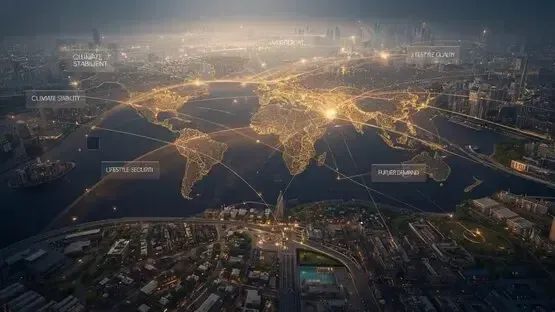
🔍 What Smart Investors Are Starting To Watch
The most forward-looking investors increasingly monitor signals that barely appeared on real estate checklists twenty years ago.
Such as:
Climate Stability
How predictable are local conditions?
Water Security
Can the region support long-term growth?
Infrastructure Adaptability
How quickly can the city respond to change?
Seasonal Livability
How comfortable is daily life across the year?
Insurance Trends
Are risk costs increasing or stabilizing?
These variables may not dominate today's pricing.
But they increasingly influence tomorrow's demand.
📲 Climate Is Becoming Part Of Lifestyle Economics
As discussed in:
👉 people increasingly choose locations based on quality of life rather than pure economic opportunity. Climate is becoming part of that calculation. Not because buyers are making environmental statements. Because they are making lifestyle decisions. And lifestyle decisions create market outcomes.
🌱 The Most Valuable Asset May Be Predictability
Many investors chase growth. Few appreciate predictability. But predictability creates:
- confidence
- liquidity
- financing stability
- long-term demand
And climate resilience often contributes to all four.
📊 A New Layer Of Real Estate Analysis
For decades, location was everything. Increasingly, location requires context. Two coastal cities may look similar today. But future demand may treat them very differently. The difference may not be visible in architecture. Or infrastructure. Or even pricing. Yet.
🔮 Propertiso Future Signal
Weak Signal Today
Climate considerations are increasingly appearing in relocation decisions, insurance pricing, urban planning, and long-term investment strategies.
What It Could Mean by 2035
Climate resilience may become a core component of property valuation, alongside traditional factors such as location and accessibility.
Confidence Level
⭐⭐⭐⭐⭐
📊 Climate And Property Value Matrix
- Location — Historical: Very High | Future: Very High
- Employment Access — Historical: Very High | Future: High
- Infrastructure — Historical: High | Future: Very High
- Climate Stability — Historical: Low | Future: High
- Water Security — Historical: Low | Future: High
- Lifestyle Quality — Historical: Medium | Future: Very High
- Adaptability — Historical: Low | Future: High The list of value drivers is expanding. Not replacing. Expanding.
📊 Propertiso Insight Index (CIS)
🔴 High CIS (Emotional Market)
- buyers focus on lifestyle narratives
- climate risks are often ignored
- short-term demand dominates
🟡 Medium CIS
- awareness increases
- buyers begin comparing resilience factors
- risk enters decision-making
🟢 Low CIS (Rational Market)
- long-term fundamentals dominate
- resilience becomes a competitive advantage
- climate-adjusted value gains importance
Key Insight
The more rational markets become,
the more climate transforms from a lifestyle consideration into an investment variable.
🌐 Related Insights
❓ Questions Investors Are Starting To Ask
- How does climate affect property values?
- Which regions may benefit from climate migration?
- Will climate resilience influence housing demand?
- Can insurance costs reshape real estate markets?
- What makes a location future-proof?
- How will climate impact investment decisions by 2035?
These questions were once niche.
Increasingly, they are becoming mainstream.
The Quiet Repricing
Most major real estate shifts begin before they appear in market reports. Before headlines. Before consensus. Climate may be following the same path. Not as a political story. Not as a social story. As a capital story. Because ultimately, property values reflect where people want to live. And where people feel confident building their future. The next decade may reveal that climate was never simply about weather. It was about demand. And demand has always been one of the most powerful forces in real estate.